
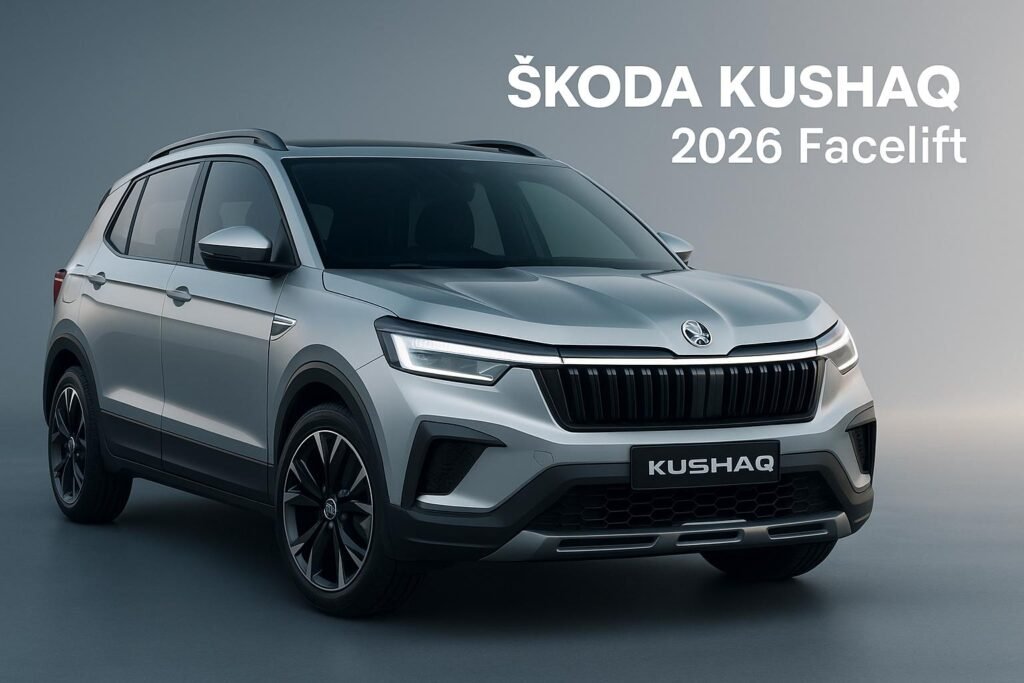
The Skoda Kushaq Facelift is slated for launch in early 2026, and it aims to give the compact SUV a significant upgrade in features, design, comfort, and technology. With rising competition in the SUV space — including new rivals — this facelift could help the Kushaq stay relevant and more appealing to buyers seeking a premium but practical SUV.
At the core: updated looks, a richer feature list (including a segment-first rear-seat massage function), more comfort and safety, and subtle mechanical tweaks. Here’s a comprehensive look at what’s new, what’s carried over, and how it stacks up in 2026.
Feature & Specification Highlights of Skoda Kushaq Facelift
| Feature / Update | What’s New / Changed (Facelift 2026) | Carried Over / Unchanged |
|---|---|---|
| Rear Seat Comfort | Segment-first rear-seat massage function on higher trims | Standard seating layout retained |
| Sunroof / Roof | Larger panoramic sunroof on premium variants | Same body shell / roofline |
| ADAS & Safety Tech | Expected Level-2 ADAS (lane-assist, adaptive cruise, etc.), 360° camera, updated electronics suite | Basic safety kit and crash-tested structure remains |
| Digital Interface | Updated graphics for digital instrument cluster + touchscreen infotainment, improved UI designs | Infotainment + cluster layout will remain broadly similar |
| Brakes & Wheels | Rear disc brakes for certain 1.5 TSI variants; refreshed new alloy wheel design, possibly black-out finish wheels. | Alloy size and tyre options to align with variant levels |
| Exterior Styling | Tweaked front fascia: revised grille with slimmer slats, reworked headlamps & fog-lamps, updated front & rear bumpers, new tail-lamp design, connected LED strip at back, new blacked-out wheels. | Overall SUV footprint and dimensions remain unchanged |
| Engines & Gearbox | Engines same: 1.0-litre TSI (115 hp / 178 Nm) and 1.5-litre TSI (150 hp / 250 Nm) retained. For 1.0-TSI auto, future switch to an 8-speed torque-converter automatic is a possibility (likely post-launch). | Manual and 7-speed DCT (for 1.5 TSI) likely to continue unchanged initially |
Also Read: Honda Amaze 3rd Gen Crash Test – 5-Star Bharat NCAP Safety Rating

Why Skoda Chose These Updates — Strategic Thinking
Refresh to Stay Competitive
Compact / midsize SUVs in India are evolving fast, with new launches featuring more comfort, technology and safety. The Skoda Kushaq Facelift seems designed to keep pace — introducing features largely missing in its current avatar (rear-seat comfort, panoramic roof, ADAS, refreshed interior) without changing the underlying platform.
Upping Comfort and Premium Feel
By adding rear-seat massage and panoramic sunroof, Skoda aims to shift Kushaq’s positioning slightly upward — appealing to buyers seeking more comfort and premium feel, not just basic SUV practicality.
Meet Evolving Safety & Feature Expectations
With the facelift, the Kushaq could integrate Level-2 ADAS and other modern safety/assistance features — aligning with stricter safety expectations and making it competitive against newer SUVs with similar tech.
Minimal Mechanical Disruption, Maximum Impact
Keeping engines unchanged reduces risk and cost for the manufacturer, while delivering visible upgrades (styling, features) — a smart balancing act for mid-cycle refresh.
Also Read: Mahindra BE6 Formula E Edition Launch 2025

What the Skoda Kushaq Facelift Means for Buyers — Strengths & What to Watch
What Works
- Feature-loaded cabin & comfort: Rear seat massage (unique in segment), panoramic sunroof, ADAS, improved braking — a big package for the price band.
- Refreshed styling: Updated headlamps, sharper front and rear fascias, LED DRLs/tail-lamps, updated alloys — gives newer, more premium look.
- Safety and tech upgrades: With disc brakes, Level-2 ADAS, 360° camera, updated electronics — better safety and usability.
- Familiar powertrains: Retaining popular 1.0-liter and 1.5-liter TSI petrol engines maintains known performance and efficiency levels.
Also Read: Tata Sierra 2025 Drive Review – Stunning Design, Solid Ride & Some Rough Edges
What Buyers Should Know / Monitor
- Interior or mechanical copies not confirmed: Full details on upgraded interiors (materials, upholstery, AC system) are still under wraps. Buyers should wait for official reveal before assuming premium cabin feel.
- Gearbox upgrade may come later: The 8-speed torque converter auto — a likely major selling point — may not be available at launch; 6-speed AT / 7-DCT may continue initially.
- Price increase expected: With added features, updated styling and safety/tech upgrades, expect the facelifted variants to be priced higher; prospective buyers should consider total cost vs equipment.
- Real-world benefit vs hype: Features like rear-seat massage or panoramic sunroof are attractive, but long-term reliability, rear-seat comfort space, after-sales support, and maintenance costs will matter — especially in India’s varied conditions.

Where Skoda Kushaq Facelift Fits in the Market — Rivals & Positioning
The facelifted Kushaq will compete in the crowded compact / midsize SUV space: against rivals such as Hyundai Creta, Kia Seltos, Tata Sierra, Maruti Grand Vitara, and other upcoming SUVs.
With the facelift, Kushaq aims to differentiate itself via its European feel — crisp design, feature-rich package, safety & stability — while offering familiar maintenance and service network of Skoda. The added comfort (sunroof, massage) could make it more appealing to urban buyers looking for “SUV + premium sedan” hybrid utility.

Also Read: Renault Cars Discounts December 2025 – Savings Up to ₹1.05 Lakh Off
Launch & Official Reveal Timeline
- The Skoda Kushaq Facelift is expected to be officially launched in second half of January 2026.
- Skoda is likely to announce variant-wise feature list and pricing around the launch date. As of now, spy shots and supplier leaks suggest top trims get full features while lower trims may get selective updates.
- Buyers interested in rear-seat comfort (massage), sunroof, ADAS and updated styling should consider waiting for the facelift — but should also check after-sales support, variant-wise availability, and real-world feature utility before booking.